
Common App Essay Prompts 2026-2027: How to Choose the Right Topic
The Common App essay prompts for 2026-2027 are broad on purpose. They are not asking for one correct kind of story. They are giving you several doors into the same goal: show admissions readers how you think, what you value, and how you have changed.
Most weak essays fail before drafting starts. The student chooses a topic because it sounds impressive instead of because it reveals something specific. The better strategy is to choose the story first, then match it to the prompt.
The Real Purpose of the Common App Essay
Your personal statement is not a resume paragraph. It should not repeat your activity list, explain every achievement, or prove that you are perfect.
The essay should answer questions the rest of the application cannot:
- What do you notice that other people miss?
- How do you respond when something matters to you?
- What kind of community member are you?
- What has shaped the way you think?
- How have you grown through experience?
If the essay does not reveal a human being, the prompt choice will not save it.
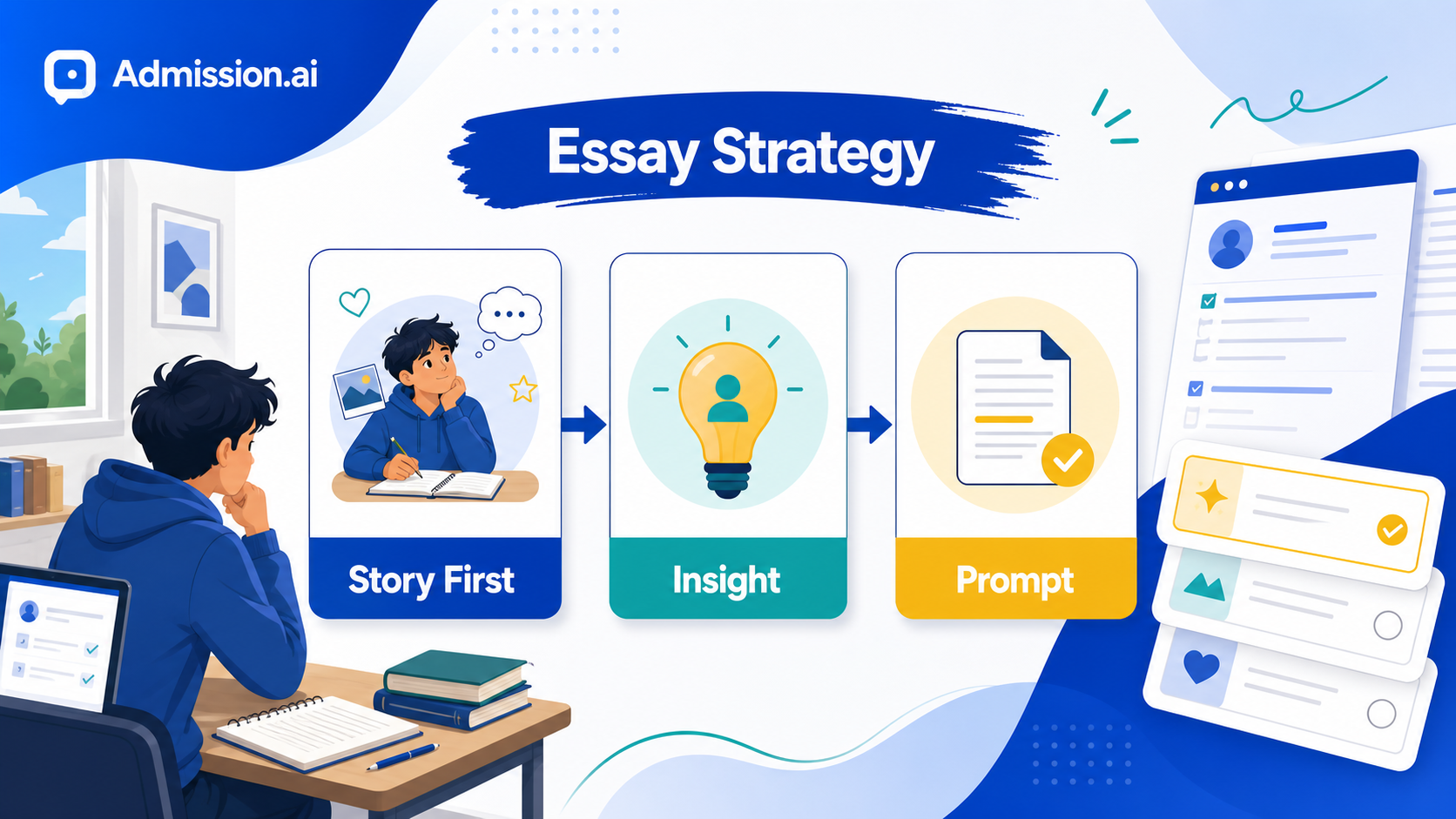
Start With a Story Inventory
Before picking a prompt, build a list of 12 to 15 possible moments. Keep them specific. "Volunteering" is too broad. "The afternoon I realized our food pantry intake form was humiliating for families" is specific.
Good essay moments often come from:
- A small conflict that changed your view
- A responsibility you took seriously
- A private obsession or curiosity
- A family habit that shaped your values
- A failure that forced a better method
- A place where you felt out of sync, then found your footing
- A problem you kept returning to even without external rewards
You are looking for narrative pressure. Something should shift between the beginning and end of the essay.
Prompt 1: Background, Identity, Interest, or Talent
This prompt works when the topic is genuinely central to how you move through the world. It is a strong fit for cultural identity, family responsibilities, unusual intellectual interests, language, place, or a talent that has shaped your daily life.
The trap is writing a static identity essay. Do not only explain what your background is. Show how it affects decisions, relationships, curiosity, or ambition.
Best structure:
- Open with a concrete scene
- Show the tension or misunderstanding
- Explain how the background shaped your response
- End with how it now influences your future choices
Prompt 2: Challenge, Setback, or Failure
This is one of the most overused prompts because every student has faced difficulty. The difference between a strong and weak version is ownership.
A weak version says, "This was hard, but I worked hard and succeeded."
A strong version says, "This exposed a flaw in my assumptions, and I changed my behavior."
Avoid trauma dumping. The admissions reader does not need every painful detail. They need to see reflection, agency, and growth.
Prompt 3: Questioning a Belief or Idea
This prompt is excellent for students who think independently. It can work for classroom debates, family expectations, political assumptions, religious questions, scientific disagreements, or social norms.
The key is maturity. Do not write an essay where everyone else is wrong and you are enlightened. Show that you can revise your own thinking too.
Strong essays under this prompt often end with a more nuanced position than the one the student held at the beginning.
Prompt 4: Gratitude
This prompt can be powerful because it shifts attention away from achievement and toward relationship. It works when the act of gratitude changed how you behaved afterward.
The mistake is writing a thank-you note. The essay is not really about the person who helped you. It is about what their action revealed and how that changed you.
Ask:
- What did I understand only later?
- What did this person see in me before I saw it myself?
- How did my behavior change because of this gratitude?
Find your perfect university match
Get personalized recommendations based on your profile and goals.
Prompt 5: Personal Growth
This is often the most flexible prompt. It fits almost any story where the student can show a before and after.
Because it is broad, it also invites generic writing. Avoid phrases like "I learned the value of hard work" or "I became a better leader." Replace them with specific evidence.
Better ending:
"Now, before I start a project, I ask who will have to maintain it after the exciting launch is over."
Weaker ending:
"This experience taught me leadership."
Prompt 6: Captivating Topic, Idea, or Concept
This is the intellectual curiosity prompt. It is ideal for students who have a genuine academic or creative obsession.
The topic itself does not have to be rare. The thinking has to be alive. A great essay can be about bus routes, fungi, ancient coins, cooking chemistry, cricket statistics, machine translation, or neighborhood zoning if the student's curiosity feels real.
Use this prompt if you can show:
- How the interest started
- What questions you asked next
- What you did beyond assigned work
- How the interest changed your way of seeing other things
Prompt 7: Topic of Your Choice
This is not a loophole. It is permission to use the best story even if it does not fit neatly elsewhere.
Choose prompt 7 when your essay has a strong shape but labeling it under another prompt feels forced. Admissions readers do not care which prompt you choose. They care whether the essay works.
How to Pick the Best Prompt
Use this test:
- Write a one-sentence summary of the story
- Write what the reader should learn about you
- Identify the moment of change
- Match the story to the prompt only after those three answers are clear
If you cannot explain the change, the essay probably is not ready.
What Not to Do in 2026-2027
Avoid these patterns:
- The resume essay that lists accomplishments
- The sports injury essay with no original reflection
- The service trip essay where the community becomes a prop
- The AI-polished essay that sounds too smooth to be personal
- The "I learned hard work" ending
- The essay about another person where you disappear
Admissions officers read thousands of essays. Familiar topics can still work, but only if the thinking is specific.
How admission.ai Can Help
The best use of AI is feedback, not authorship. Use admission.ai to test whether your essay has a clear arc, whether the opening scene earns attention, whether the ending says something specific, and whether the writing still sounds like you.
Do not outsource the voice. Your essay should feel like a sharper version of your own thinking, not like a committee wrote it.
The prompt is the container. The story is the application asset. Choose the story that makes you more real.
Continue Reading
More articles you might enjoy
 Essay Writing
AI and College Application Essays 2027: What Is Safe, What Is Risky, and What Gets Flagged
Students are using AI more than ever, but application platforms and colleges draw a hard line around authenticity. Here is the safe way to use AI for college essays.
Essay WritingHow to Write a College Essay 2026: The Complete Guide That Actually Works
Stop following generic essay advice. This guide reveals what admissions officers actually want to read and how to write essays that get you accepted in 2026.
 Essay Writing
Common App Essay Prompts 2026-2027: Complete Guide with Examples
Master the Common App essay prompts for 2026-2027 admissions. Detailed analysis, winning strategies, and examples that got students into top colleges.