
AI and College Application Essays 2027: What Is Safe, What Is Risky, and What Gets Flagged
AI is now part of the college application process whether admissions offices like it or not. Students use it to brainstorm, organize, edit, translate, summarize, and panic-check essays at midnight. The problem is that there is a bright line between support and misrepresentation.
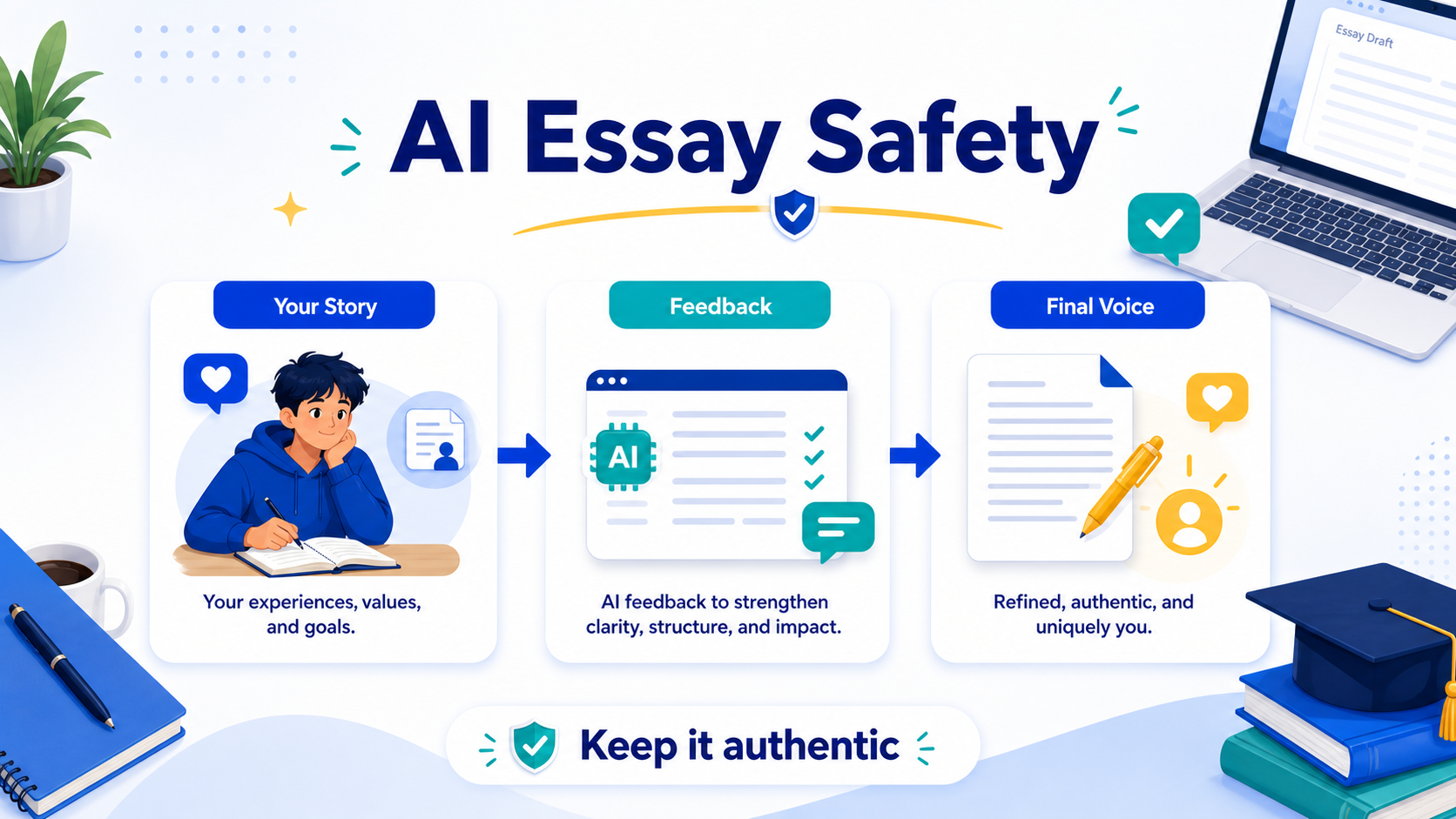
For 2027 applicants, the safest rule is this: AI can help you think, but it should not become the author of your application.
Why This Matters More in 2027
Admissions offices are no longer surprised by AI-generated writing. They have seen the patterns: polished but vague essays, sentences that sound impressive without revealing much, activity descriptions that inflate ordinary work, and personal statements with no believable teenage voice.
Application platforms also treat authenticity seriously. Submitting work generated by another person or system can be considered a fraud issue when it replaces the student's own writing.
That does not mean every use of AI is forbidden. It means students need a disciplined workflow.
Safe Uses of AI
AI is safest when it helps you evaluate your own thinking without replacing it.
Good uses include:
- Brainstorming possible essay angles from experiences you provide
- Asking whether an essay has a clear beginning, tension, and resolution
- Checking if a paragraph repeats information from the activity list
- Identifying vague sentences that need more specific detail
- Creating a revision checklist
- Helping you understand a college's supplemental essay prompt
- Suggesting questions you should answer in your own words
In each case, the raw material and final language should remain yours.
Risky Uses of AI
Risk rises when AI produces language that goes directly into the application.
Risky uses include:
- Asking AI to write a personal statement draft
- Asking AI to rewrite your essay in a more impressive voice
- Using AI-generated metaphors, anecdotes, or emotional conclusions
- Letting AI invent details about your activities
- Using AI to make every sentence sound polished
- Translating an essay into English without reviewing whether it still reflects your actual voice
The danger is not only detection. The bigger danger is quality. AI tends to flatten the personal, strange, and memorable details that make essays work.
What AI-Written Essays Sound Like
AI essays often have recognizable weaknesses:
- They explain lessons too directly
- They use polished transitions instead of real narrative movement
- They rely on phrases like "profoundly shaped me" or "ignited my passion"
- They make the student sound older, smoother, and less specific than a real applicant
- They mention growth without showing the uncomfortable moment that caused it
Admissions readers do not need software to notice when an essay feels generic. A technically clean essay can still be forgettable.
The Authenticity Test
Before submitting any essay, ask five questions:
- Could I explain every sentence out loud without feeling like I am performing?
- Are the details specific enough that another student could not easily claim the same story?
- Does the essay include a real moment of uncertainty, friction, or change?
- Does the ending say something more precise than "I learned resilience"?
- Would someone who knows me recognize the voice?
If the answer to any question is no, revise.
Find your perfect university match
Get personalized recommendations based on your profile and goals.
A Safe AI Workflow for Essays
Use this workflow if you want help without crossing the line.
Step 1: Draft Without AI
Write a messy first draft yourself. It can be bad. It can be too long. It can be awkward. The first draft protects your real voice.
Step 2: Ask Diagnostic Questions
Instead of asking AI to rewrite, ask:
- What is the central change in this essay?
- Where does the essay become vague?
- Which sentence sounds least like a teenager?
- What questions would an admissions reader still have?
- Which details should be expanded?
Step 3: Revise Manually
Use the feedback as a checklist. Rewrite the essay yourself. Keep your syntax, your humor, your rhythm, and your specific memory.
Step 4: Run a Voice Check
Ask whether the essay sounds consistent with the student's own voice. If the feedback suggests making it "more sophisticated," be careful. Sophistication is less valuable than authenticity.
Step 5: Keep Version History
Save your drafts. If a counselor, parent, or platform ever asks about process, you should be able to show development from notes to draft to revision.
Supplemental Essays Need Even More Care
Supplemental essays are short, specific, and easy for AI to ruin. A "Why this college?" essay filled with generic praise is a fast way to look unserious.
For supplementals, AI can help you build a research checklist, but you should write the final answer from real fit:
- Courses you would actually take
- Professors or labs connected to your interests
- Campus programs you understand
- Communities you would contribute to
- Problems you want to explore there
If the essay could be sent to five different colleges with minor name changes, it is not specific enough.
International Students and Translation
International applicants face a real challenge: writing in English while preserving voice. AI translation can help with clarity, but it can also erase personality.
A safer approach:
- Draft in the language where your thinking is strongest
- Translate for meaning
- Rewrite the English version manually
- Ask whether the final essay still sounds like a student, not a brochure
Do not let translation tools make the essay more formal than you are.
The Best Use of admission.ai
admission.ai is most useful as an essay coach:
- It can identify unclear logic
- It can point out generic phrasing
- It can help compare topic options
- It can flag missing specificity
- It can suggest revision priorities
Use it to make better decisions. Do not use it to manufacture a personality.
Bottom Line
AI is not the enemy of good college essays. Laziness is. The winning approach is to use AI for structure, pressure-testing, and feedback while keeping the memories, decisions, sentences, and final voice human.
Admissions readers are not looking for flawless writing. They are looking for evidence of a real person who will bring something specific to campus. Protect that.
Continue Reading
More articles you might enjoy
 Essay Writing
Common App Essay Prompts 2026-2027: How to Choose the Right Topic
The 2026-2027 Common App prompts are live. Learn how to choose the prompt that reveals the strongest version of your story without sounding generic.
Essay WritingHow to Write a College Essay 2026: The Complete Guide That Actually Works
Stop following generic essay advice. This guide reveals what admissions officers actually want to read and how to write essays that get you accepted in 2026.
 Essay Writing
Common App Essay Prompts 2026-2027: Complete Guide with Examples
Master the Common App essay prompts for 2026-2027 admissions. Detailed analysis, winning strategies, and examples that got students into top colleges.