Washington State University
Washington's land-grant research university, centred on a residential college town in the rolling hills of the Palouse.
- Acceptance rate
- 86%
- First-year students entering fall 2025 (Common Data Set 2025-26)
- Students
- 25,477
- 21,400 undergraduates
- International
- 5%
- of students
- Student–faculty
- 14:1
- ratio
- Tuition
- $32,030
- 2026-27
About WSU
Washington State University was founded in 1890 as Washington's land-grant college and took its current name in 1959. Its flagship residential campus sits on a hill in Pullman, in the wheat country of the Palouse in southeastern Washington, seven miles from the Idaho border, and the university also runs campuses in Spokane, Tri-Cities, Vancouver and Everett plus an online Global Campus. In fall 2025 WSU enrolled 25,477 students systemwide, including 21,400 undergraduates; about 16,250 study in Pullman.
WSU's 11 academic colleges include the Carson College of Business, the Edward R. Murrow College of Communication, the Voiland College of Engineering and Architecture, the College of Veterinary Medicine, the Elson S. Floyd College of Medicine and colleges of Pharmacy and Nursing, alongside an all-university Honors College that is one of the oldest in the country. Research is rooted in agriculture and animal health, from high-yield dwarf wheat to Cougar Gold cheese made at the WSU Creamery and a School for Global Animal Health whose research facility was largely funded by the Gates Foundation.
Admission is accessible: WSU admitted 22,732 of 26,403 first-year applicants for fall 2025 (86.1%) and does not use SAT or ACT scores. It suits students who want a classic residential college-town experience with Pac-12 sports, strong agriculture, veterinary and communication programs, and the outdoors of the inland Northwest.
Why students choose WSU
The College of Veterinary Medicine and its global animal health research, supported by a $25 million Gates Foundation grant.
The Edward R. Murrow College of Communication, named for the broadcast journalist who is among WSU's best-known alumni.
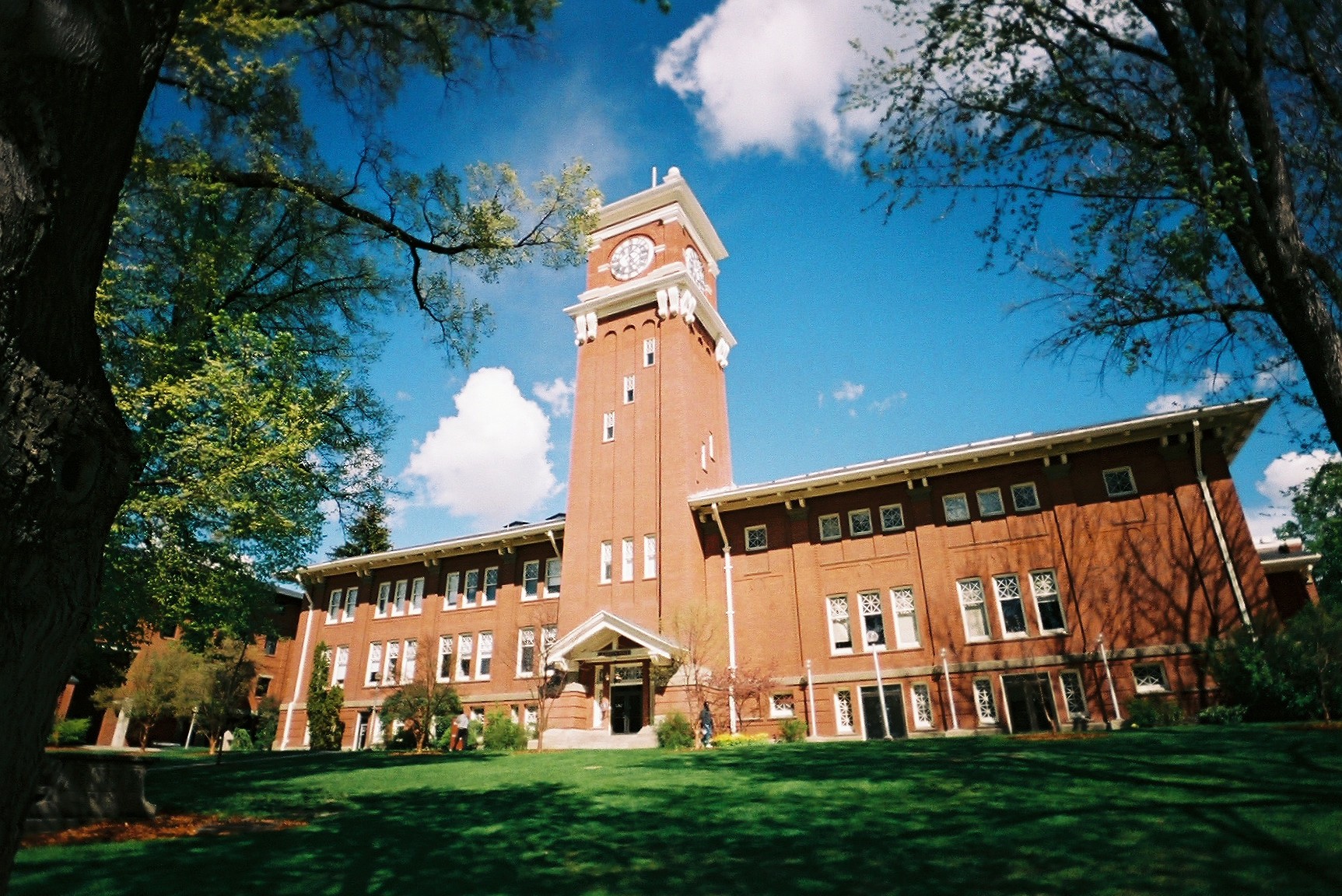
A true college town: a hilltop residential campus with red-brick and basalt buildings, Greek Row on College Hill and a 160,000 sq ft Student Recreation Center.
Test-free admission: WSU does not require or use SAT/ACT scores, and a single General Scholarship Application covers more than 700 scholarship programs.
Admissions
First-year students entering fall 2025 (Common Data Set 2025-26)
22,732 admitted from 26,403 applicants
4,420 first-years enrolled. Washington residents made up 15,845 applicants and 13,466 admits; 9,902 out-of-state applicants yielded 8,676 admits, and 590 of 656 international applicants were admitted. Applications after the March 31 priority date are accepted on a space-available basis.
Typical entry requirements
| US high school | Meet Washington's College Academic Distribution Requirements (CADR) for core courses; SAT/ACT not used |
|---|---|
| International first-year | 12 years of schooling ending in a secondary certificate or external exam, with at least a 2.70 GPA (4.0 scale) |
| English language | IELTS 6.5 Traditional admission: IELTS 6.5, TOEFL iBT 4 (new scale), Duolingo 105, PTE 58, Cambridge C1 Advanced; SAT reading and writing 500 or ACT English 17 and Reading 19 also qualify. Lower scores can lead to one-term or one-year Undergraduate Foundation pathways. Scores must be under two years old. |
Deadlines
- Scholarship and Top Scholars priority date Non-binding Next deadline · In ~4 monthsJanuary 31, 2027
Admission application, materials, General Scholarship Application and FAFSA/WASFA due for early awarding and Top Scholar consideration.
- Fall 2027 first-year priority date Non-binding In ~6 monthsMarch 31, 2027
Required for automatic awards such as the University Achievement Award and WUE/Cougar Award; later applications accepted on a space-available basis. Confirm enrollment by May 1.
- International fall application deadline Non-binding In ~8 monthsJune 15, 2027
Rolling admission; all documents due July 1. Paying the $500 Enrollment and Orientation Fee by May 1 gives priority for housing.
Dates are from WSU's 2026-2027 admissions calendar (applications opened August 3, 2026) and the Top Scholars page for the 2027-28 academic year; international dates are WSU International Programs' recurring deadlines. WSU has no Early Decision or Early Action.
How to apply
WSU application or Common App (first-years); $70 fee or waiver; upload your high school transcript with the application; WSU General Scholarship Application and FAFSA/WASFA by January 31 for priority awarding. No test scores. International students can also apply through Cialfo.
What admissions looks for
- Completion of Washington's College Academic Distribution Requirements (CADR), the core courses required for admission to a Washington four-year college.
- Your high school GPA and coursework; test scores play no part.
- For international applicants, a completed secondary qualification with at least a 2.70 GPA and proof of English proficiency.
- For Top Scholars, a 3.6+ unweighted GPA plus academic interest, courses taken, financial need and National Merit status.
Tips for applying to WSU
- 1 Submit your admission and General Scholarship applications by January 31 to be considered for Top Scholars and early scholarship awarding.
- 2 Out-of-state students should apply by March 31 to be automatically considered for the WUE/Cougar Award.
- 3 Upload your transcript with the application: WSU does not accept transcripts by email.
- 4 International students below the direct-entry English score can still enter through the Undergraduate Foundation pathway.
What are your chances?
Sign up to see your personalized admission chances for Washington State University
Sign up to see your chancesCosts & financial aid
2026-27 · figures in USD
WSU awards about $170 million a year in scholarships, grants and waivers across more than 700 programs, all reached through one General Scholarship Application. First-years who apply by March 31 are automatically considered for waivers such as the University Achievement Award and, for out-of-state students, the WUE/Cougar Award. International undergraduates receive limited institutional aid: 216 received it in 2025-26, averaging $10,094.
- $36,188
- 2026-27 cost of attendance, Pullman, Washington resident
- $53,860
- 2026-27 cost of attendance, Pullman, non-resident
- 83%
- Students receiving financial aid (2023-24)
- 31%
- Students paying full tuition
Academics
Academic calendar: Semesters
Veterinary Medicine
A College of Veterinary Medicine with the Washington Animal Disease Diagnostic Laboratory and Gates-funded global animal health research.
Communication (Edward R. Murrow College)
Named for alumnus Edward R. Murrow, the broadcast journalist.
Plant, animal and food sciences
WSU developed high-yield dwarf wheat and Cougar Gold cheese, still produced by the WSU Creamery from the university's dairy herd.
Honors College
An all-university honors college that is one of the oldest in the nation.
Research
- $403 million in annual research funding (FY2024) and the Carnegie designation for very high research spending and doctorate production.
- The Nuclear Radiation Center, a 1 MW TRIGA research reactor built in 1961, used by the radiochemistry program.
- The Institute for Shock Physics, with research contracts from DARPA and the Department of Energy.
- The 1968 discovery of Marmes Man at the Marmes Rockshelter in southeastern Washington, at the time the oldest human remains found in the US.
Schools & faculties
- College of Agricultural, Human, and Natural Resource Sciences
- College of Arts and Sciences
- Carson College of Business
- Edward R. Murrow College of Communication
- College of Education
- Voiland College of Engineering and Architecture
- Elson S. Floyd College of Medicine
- College of Nursing
- College of Pharmacy
- College of Veterinary Medicine
- Honors College
College Scorecard: median earnings of $68,905 ten years after entry (and $53,510 six years after entry) for federally aided students.
Student life
WSU Pullman is a residential campus: many first-years live in residence halls, each with its own hall government, from the small historic Stevens Hall to the large Stephenson Complex, while Greek Row on College Hill is home to dozens of fraternities and sororities. The Student Recreation Center was the largest in the US when it opened in 2001, and the Palouse Ridge championship golf course sits on campus. The Cougars play football at Martin Stadium in the heart of campus, and nearby Kamiak Butte, Steptoe Butte and Moscow Mountain offer hiking and biking.
- Washington State Cougars in the Pac-12 Conference, which resumed full operations in 2026.
- Cougar Gold, the canned white cheddar made at the WSU Creamery since the 1940s research that created it.
- Greek Row on College Hill with more than 60 fraternities and sororities across four councils.
- The 160,000 sq ft Student Recreation Center with an elevated indoor track.
Housing. Many first-years live in on-campus residence halls, and after first year many students move to apartments, several of them owned by WSU.
Location
Pullman is a small college town in the Palouse, a region of rolling wheat, pea and lentil fields in southeastern Washington, about 2,500 feet above sea level and seven miles from Moscow, Idaho, home of the University of Idaho. Life revolves around campus, with buttes and mountains nearby for hiking and biking and the Snake River for water sports.
Nearest airport: Pullman-Moscow Regional Airport (PUW); Spokane International Airport (GEG)
Notable alumni
- ER Edward R. MurrowBroadcast journalist
- GL Gary LarsonCartoonist, creator of The Far Side
- WJ William Julius WilsonSociologist (PhD)
- JM John M. FabianNASA astronaut
- BL Bernard LagatOlympic middle- and long-distance runner (BA 2000)
- PJ Phyllis J. CampbellBanking executive
- AC Ana CabreraJournalist and news anchor
- ES Edmund SchweitzerFounder of Schweitzer Engineering Laboratories (PhD 1977)
Frequently asked questions
What is Washington State University's acceptance rate?
WSU admitted 22,732 of 26,403 first-year applicants for fall 2025, an acceptance rate of about 86%.
Does WSU require the SAT or ACT?
No. WSU does not require SAT or ACT scores and does not use them in admission decisions.
When is the WSU application deadline for fall 2027?
The first-year priority date is March 31, 2027, with later applications accepted on a space-available basis. Apply and submit the General Scholarship Application by January 31, 2027 for early scholarship awarding and Top Scholar consideration.
How much does WSU cost for out-of-state students?
For 2026-27 at Pullman, non-resident tuition and fees come to about $32,030 a year and the full cost of attendance is $53,860. Out-of-state students who apply by March 31 are automatically considered for the WUE/Cougar Award.
What English score do international students need for WSU?
For traditional admission you need IELTS 6.5, TOEFL iBT 4 on the new scale, Duolingo 105 or PTE 58; lower scores can qualify for the Undergraduate Foundation pathway.
Sources & methodology
Figures on this page were checked against official university publications, national application services and ranking publishers in September 2026. Each number is shown with the year or admissions cycle it describes. Always confirm deadlines and fees on the university's own website before applying.
Explore nearby in the world top 100
Universities ranked close to WSU in the QS World University Rankings 2027.