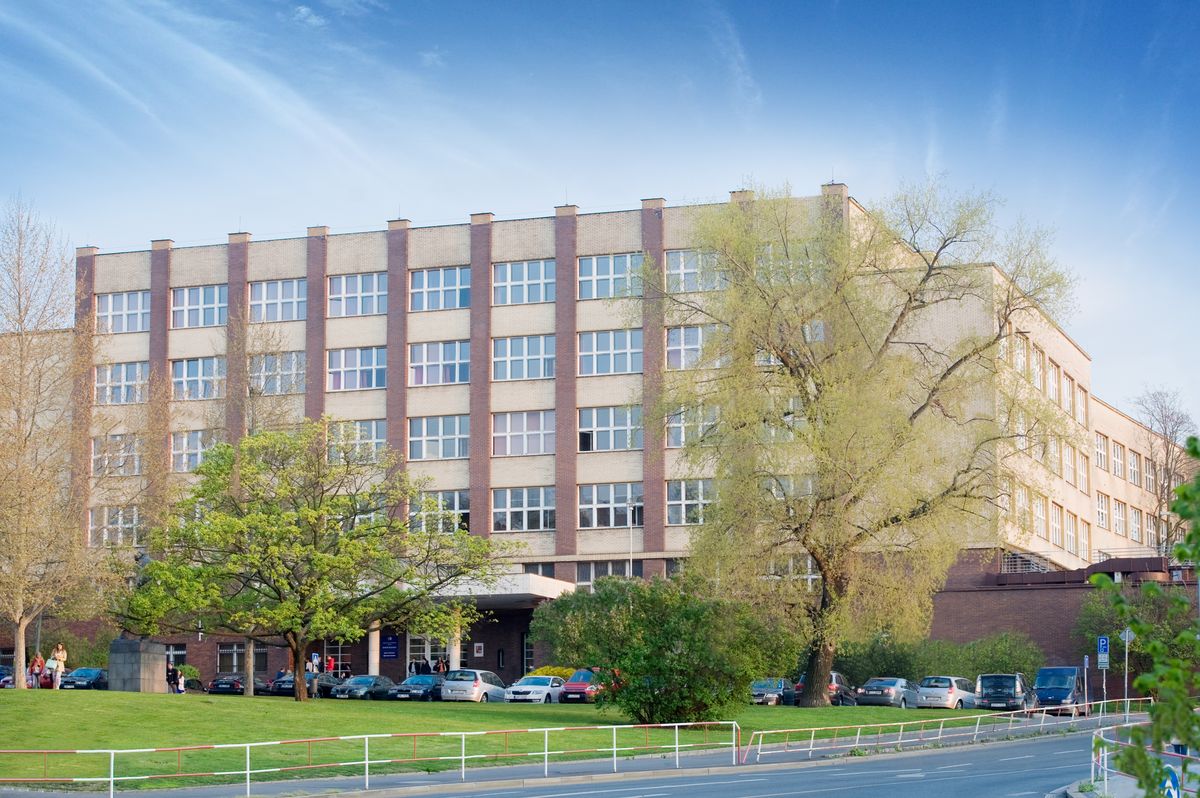
Prague University of Economics and Business
Vysoká škola ekonomická v Praze
The Czech Republic's largest public economics and business university, with English-taught bachelor's degrees at EUR 6,000 a year.
- Students
- 14,000
- Tuition
- €6,000
- 2027-28
- Founded
- 1953
- QS World Ranking
- 1001-1200
- 2027 edition
About VŠE
The Prague University of Economics and Business (VŠE) was founded in 1953 and is the largest public university in economics and business in the Czech Republic. Five of its six faculties are in central Prague (Finance and Accounting, International Relations, Business Administration, Informatics and Statistics, and Economics), and the Faculty of Management is in the town of Jindřichův Hradec.
It has about 14,000 students according to its own About page (its admissions site says about 13,000). This autumn it welcomed more than 500 exchange students from over 50 countries and more than 700 new students in its English-taught degree programmes, and its admissions site says students come from over 90 countries. In March 2024 it became the first university in the Czech Republic to gain AACSB accreditation, and its Faculty of Business Administration is EQUIS accredited. VŠE is a member of the CEMS alliance and cooperates with more than 250 partner universities.
International applicants choose among English-taught bachelor's programmes including Business Administration, Economics, International Business, International and Diplomatic Studies, Economics of Markets and Organizations (run with CERGE-EI) and Economic Data Science. Finance and Accounting and a new Business Information Systems and Computer Science programme start in September 2027. Tuition for 2027/28 entrants is EUR 6,000 a year, and university accommodation is guaranteed to international students who apply on time. It suits applicants who want a business-focused degree in a central European capital.
Why students choose VŠE
Bachelor's programmes are taught in English and cost EUR 6,000 a year for students entering in 2027/28.
VŠE holds AACSB accreditation (the first in the Czech Republic, March 2024), and its Faculty of Business Administration is EQUIS accredited.
International Business (IBB) students can earn a double degree in their third year at the University of Vaasa in Finland or OTH Regensburg in Germany.
All international students are guaranteed university accommodation if they apply within the deadline.
Admissions
2027/28 academic year (September 2027 intake)
Selectivity
VŠE does not publish an overall acceptance rate. Admission requires passing an entrance examination whose requirements differ by programme; the university advises checking each programme's website.
Typical entry requirements
| Secondary school leaving certificate | Diploma plus a certificate confirming it allows you to apply for a bachelor's degree in your country; if you are still studying, a confirmation of study with the expected graduation date and your current transcript. |
|---|---|
| Recognition of previous education | Part of the application; since 1 December 2024 it is integrated into the application in the InSIS information system. |
| English language | English-taught programmes set their own language requirements; check the individual programme website. The central admissions page did not list minimum scores. |
Deadlines
- Application period for 2027/28 Non-bindingOpens 1 November 2026; closing dates not yet published
New programme Business Information Systems and Computer Science also opens applications in November 2026 for a September 2027 start.
- Previous cycle: last call for Bachelor of Business Administration and Economics of Markets and Organizations Non-binding10 June 2026
From the 2026/27 cycle; classes started on 21 September 2026.
The application process for 2027/28 opens on 1 November 2026 (admissions.vse.cz, checked 30 September 2026); no closing date is published yet. The 10 June 2026 last-call date is the previous (2026/27) cycle. The 2026/27 application process had already closed.
How to apply
Choose a programme, register and submit the e-application in the VŠE information system (InSIS) and pay the non-refundable application fee of EUR 100 there. After admission you confirm your intention to study through InSIS by your faculty's deadline, pay tuition before the semester starts, and, if you are a non-EU citizen, obtain a long-term student visa before arriving.
What admissions looks for
- A secondary school diploma that is valid for bachelor's study in your country.
- Success in the programme-specific entrance examination.
- Complete, verifiable documents: VŠE assesses foreign education as part of every application.
Tips for applying to VŠE
- 1 Contact the coordinator of your programme before applying: each bachelor's programme has its own coordinator for admission questions.
- 2 Apply early in the window that opens on 1 November 2026, since places in some programmes were still open for a last call in June in the previous cycle.
- 3 Non-EU citizens need a long-term visa for study before arriving, so start the visa steps as soon as you are admitted.
- 4 If you want university housing, apply for it within the deadline: international students are guaranteed a place if they do.
Costs & financial aid
2027-28 · figures in EUR
VŠE says it offers no scholarships or financial assistance other than merit-based scholarships. The Czech government offers development-assistance scholarships to citizens of listed countries for certain master's programmes (application deadline 30 September 2026 for 2027/28), and students can look at Visegrad Fund grants. Students who take the government scholarship cannot use it for programmes with tuition fees.
- EUR 100, non-refundable (a June 2026 last-call notice quoted EUR 50)
- Application fee
- EUR 6,000 per year
- Bachelor's tuition (2027/28 entrants)
- About EUR 7,000 per academic year
- Estimated living costs
Academics
Academic calendar: Two semesters: winter classes start in mid-September, summer classes in mid-February; each semester has 13 lecture weeks and a 6-week exam period
Bachelor of Business Administration (BBA)
Offers incoming students a double degree option with KEDGE Business School in Bordeaux.
Bachelor of International Business (IBB)
Third-year double degree option with the University of Vaasa in Finland or OTH Regensburg in Germany.
Bachelor of International and Diplomatic Studies (IDS)
A three-year, six-semester English-taught programme on international politics, economics, law and diplomacy, with a strong European Union focus.
Bachelor of Economics of Markets and Organizations (EMO)
Run by the Faculty of Business Administration together with the economics institute CERGE-EI.
Bachelor of Economic Data Science (EDS)
Trains students in advanced statistical and econometric analysis of data for company and public-sector roles.
Business Information Systems and Computer Science (BIS)
A new English-taught bachelor's whose first cohort starts in September 2027, with applications opening in November 2026.
Research
- VŠE holds AACSB accreditation (March 2024, the first in the Czech Republic) and the Faculty of Business Administration holds EQUIS accreditation.
- The Master in Official Statistics at the Faculty of Informatics and Statistics holds EMOS accreditation from the European Statistical System Committee.
- It belongs to CEMS and PIM and cooperates with more than 250 partner universities.
Schools & faculties
- Faculty of Finance and Accounting
- Faculty of International Relations
- Faculty of Business Administration
- Faculty of Informatics and Statistics
- Faculty of Economics
- Faculty of Management (Jindřichův Hradec)
VŠE says its graduates find employment easily in banking, accounting and auditing, sales, marketing, trade, public administration and IT, and lists Česká spořitelna (Erste Group) as a long-term general partner; no employment-rate figure was found.
Student life
VŠE has a central campus in Žižkov and international orientation activities for every intake: this September the International Office ran an Orientation Week (14 to 18 September 2026) with sessions on Czech culture, a Czech language crash course and a welcome ceremony. ESN VSE Prague runs a buddy programme for incoming students. The university offers modern sport facilities on campus and at the dormitories, and international degree students are accommodated in the Jarov dormitories.
- Orientation Week for new international students and an ESN VSE Prague buddy programme.
- Language classes in English, German, French, Russian, Italian, Portuguese, Spanish, Swedish and Chinese.
- Sport facilities at the campus and the dormitories.
- A library with more than 430,000 books.
Housing. All international students are guaranteed university accommodation if they apply within the deadline; newly enrolled degree students are placed in the Jarov area dormitories.
Location
VŠE's main campus is in Žižkov, a central district of Prague, with a second campus in the Jižní Město district and the Faculty of Management in Jindřichův Hradec about 110 km away. The admissions site calls Prague one of the more expensive Czech cities but far cheaper than most Western European capitals, and estimates living costs at about EUR 550 to 800 a month.
Nearest airport: Václav Havel Airport Prague (PRG)
Notable alumni
- VK Václav KlausEconomist; Prime Minister of the Czech Republic 1992 to 1997 and President 2003 to 2013; studied economics of foreign trade and graduated in 1963
- MZ Miloš ZemanPrime Minister of the Czech Republic 1998 to 2002 and President 2013 to 2023; studied at the University of Economics in Prague and graduated in 1969
- JT Josef TošovskýEconomist and Governor of the Czech National Bank from 1993 to 2000; studied international trade from 1968 to 1973
- ZT Zdeněk TůmaEconomist and Governor of the Czech National Bank from 2000 to 2010; studied at the Faculty of Trade from 1979 to 1983
- PK Petr KellnerEntrepreneur who built the PPF Group; died in 2021; graduated from the Faculty of Industrial Economics in 1986
- DC Dita CharanzováCzech politician; Member of the European Parliament 2014 to 2024 and its Vice-President 2019 to 2024; graduated from the University of Economics in Prague
Frequently asked questions
How much does it cost to study at VŠE in English?
For students entering in 2027/28, bachelor's and master's programmes cost EUR 6,000 per academic year (EUR 3,000 per semester). Students admitted earlier pay EUR 5,000. There is also a non-refundable EUR 100 application fee.
When do applications open for 2027 entry at VŠE?
The application period for the 2027/28 academic year opens on 1 November 2026. Closing dates were not yet published; in the previous cycle a last call ran until 10 June 2026 for two bachelor's programmes.
Does VŠE require an entrance exam?
Yes. Entrance exams must be passed, and their requirements depend on the programme, so check each programme's website.
Does VŠE provide accommodation for international students?
Yes: international students are guaranteed university accommodation if they apply within the deadline, and new degree students are accommodated in the Jarov dormitories.
How much do living costs in Prague come to?
VŠE estimates about EUR 7,000 per academic year, or EUR 550 to 800 per month, depending on lifestyle and accommodation.
Sources & methodology
Figures on this page were checked against official university publications, national application services and ranking publishers in September 2026. Each number is shown with the year or admissions cycle it describes. Always confirm deadlines and fees on the university's own website before applying.
Explore nearby in the world top 100
Universities ranked close to VŠE in the QS World University Rankings 2027.