University of New Brunswick
Canada's first English-language university, with the country's oldest engineering school and campuses in Fredericton and Saint John.
- Students
- 10,823
- 9,097 undergraduates
- Tuition
- CA$20,903
- From · 2026-27
- Founded
- 1785
- QS World Ranking
- #677
- 2027 edition
About UNB
The University of New Brunswick grew out of a 1785 petition by Loyalist settlers for an academy of liberal arts and sciences in Fredericton; it became King's College in 1828 and the secular, provincial University of New Brunswick in 1859. UNB describes itself as the first English-language university in Canada, and its engineering school, founded in 1854, is the country's oldest. In fall 2025 it enrolled about 10,800 students: roughly 9,100 undergraduates and 1,700 graduate students.
UNB has two main campuses. Fredericton, on the Wolastoq (Saint John River), hosts the faculties of Arts, Management, Computer Science, Education, Engineering, Forestry and Environmental Management, Kinesiology, Law, Nursing and Health Sciences and Science, plus the School of Leadership Studies. Saint John, opened in 1964, has its own faculties of Arts, Business, Nursing and Health Sciences, and Science, Applied Science and Engineering. Nursing is also taught in Moncton.
The university is known for engineering, geomatics, forestry, computer science and cybersecurity (it hosts the Canadian Institute for Cybersecurity), and for a literary tradition that produced Confederation Poets Bliss Carman and Charles G. D. Roberts. Admission averages are moderate, typically 65-75% for Canadian applicants, and a large scholarship program makes it a good fit for students who want a small-city, lower-cost Canadian degree with strong applied programs.
Sapere aude
“Dare to be wise” — university motto
Why students choose UNB
UNB's engineering school, established in 1854, is Canada's oldest, and engineering students can take a co-op option.
The Canadian Institute for Cybersecurity, including a national Cybersecurity Attribution Data Centre, is based on the Fredericton campus.
Canadian high school students with an 80%+ scholarship average are guaranteed a scholarship if they submit the scholarship application, and awards reach $100,000 or more.
International tuition is lower than at many Canadian universities, from about CA$20,900 a year in Arts to CA$25,900 in Engineering (2026-27, Fredericton).
Admissions
Fall 2027 entry (September 2027)
Selectivity
UNB does not publish an admit rate. It sets published minimum admission averages: 65% for Arts and Applied Arts, 70% for Forestry and Environmental Management, and 75% for most other programs including Business, Computer Science, Engineering, Science, Kinesiology and Nursing, with minimum grades in prerequisite subjects.
Typical entry requirements
| Ontario high school (example province) | English 4U plus program prerequisites; minimum admission average 65% (Arts), 70% (Forestry), 75% (Business, Computer Science, Engineering, Nursing, Science). Engineering needs at least 70% in English 4U, MHF4U, Chemistry SCH4U and Physics SPH4U. |
|---|---|
| GCE A-levels / IGCSE | O-levels plus at least 3 AS or A-level subjects; overall average of C or higher for most Arts programs and B or higher for Business, Computer Science, Science and Nursing programs, with program-specific subjects such as AS/A-level Mathematics |
| India | Class XII certificate (CBSE, CISCE or state board); country minimum grade 40%, with program averages and prerequisites applied on top |
| China | Senior high school graduation certificate, minimum grade C or 70% |
| English language | IELTS 6.5 · TOEFL iBT 85 Most programs: IELTS Academic 6.5, TOEFL iBT 85 (tests before 2026) or 4.5 on the new scale, CAEL 60, PTE 59, Duolingo 115, Cambridge 176. Nursing, Education and Arts at Fredericton, and Nursing and Health Sciences at Saint John, require IELTS 7.0, TOEFL iBT 100 (or 5), Duolingo 130 or PTE 68. Applicants without a score can be admitted conditionally through UNB's English pathway programs. |
Deadlines
- Bachelor of Education programs (Fredericton) Non-binding Next deadline · In 56 daysDecember 1, 2026
Complete application including supplementary items.
- Schulich Leader Scholarship nomination Non-binding In ~4 monthsJanuary 27, 2027
Guidance counsellor nomination; one nominee per Canadian high school.
- Bachelor of Social Work; Concurrent BEd (Saint John) Non-binding In ~4 monthsJanuary 31, 2027
- Nursing and Health Sciences Non-binding In ~4 monthsFebruary 15, 2027
Bachelor of Nursing, LPN pathways and Bachelor of Health Sciences; late applications accepted while seats remain.
- Entrance scholarship application Non-binding In ~5 monthsMarch 1, 2027
Submitted in your UNB application account after admission; covers most UNB scholarships for Canadian and international applicants.
- General deadline, fall term Non-binding In ~6 monthsMarch 31, 2027
All programs accept fall applications after their deadline while seats remain.
UNB's Dates and Deadlines page lists recurring annual dates (Dec. 1, Jan. 31, Feb. 15, March 1, March 31) without a year; they are shown here for the fall 2027 cycle. The Schulich nomination date (Jan. 27, 2027) is year-specific. The deadline to accept an offer and pay the deposit is May 15. Checked 29 September 2026.
How to apply
Apply online directly to UNB (apply.unb.ca); there is no provincial application centre. International applicants pay a CA$125 application fee and send official or notarized transcripts, English test results and any test scores; transfer applicants from outside Canada or the US need a WES ICAP evaluation. Once admitted, submit the entrance scholarship application in your UNB account by March 1. Education, Nursing and Social Work have earlier program deadlines.
What admissions looks for
- An admission average at or above the program minimum (65-75%) in the required senior courses.
- Minimum grades in program prerequisites, such as 70% in English, math, chemistry and physics for Engineering.
- English proficiency at the program's level, with higher scores for Nursing, Education and Fredericton Arts.
- For scholarships, a strong scholarship average (preference for 80%+), plus leadership, involvement or financial need for named awards.
Tips for applying to UNB
- 1 Submit the entrance scholarship application by March 1: an 80%+ scholarship average guarantees an award, but only if you apply.
- 2 International students are considered for the Lady Vi Aitken Scholarship ($40,000 over four years) through the same entrance scholarship application.
- 3 Apply by the program deadline if you want Nursing (February 15) or Education (December 1); other programs stay open after March 31 while seats remain.
- 4 If your English score is slightly short, UNB's pathway programs (PAEP in Fredericton, Saint John College) allow conditional admission and still support a study permit application.
- 5 Check your provincial requirements carefully: UNB publishes separate prerequisite lists for every province and for international curricula.
Costs & financial aid
2026-27 · figures in CAD
UNB awarded CA$12.6 million in scholarships to undergraduates in 2025-26. High school applicants with an 80%+ scholarship average are guaranteed a scholarship when they submit the entrance scholarship application by March 1; awards range from CA$500 to CA$100,000+, including the Schulich Leader, Ted Rogers Legacy (CA$100,000), Currie (CA$75,000) and Beaverbrook Scholars (CA$62,000, New Brunswick students) awards. International students are eligible for awards from CA$500 to CA$40,000, including the Lady Vi Aitken Scholarship.
- CA$12.6 million
- Undergraduate scholarships awarded, 2025-26
- 80%+ scholarship average (application required)
- Guaranteed scholarship threshold
- CA$40,000 over four years
- Lady Vi Aitken Scholarship (international)
- CA$500 to CA$40,000
- International student awards
Academics
Academic calendar: Two terms (fall and winter), plus summer
Engineering (BScE)
Canada's oldest engineering school (1854), with a co-op option and a newly expanded engineering building; minimum average 75% with 70% in math, chemistry and physics.
Geomatics / Geodesy and Geomatics Engineering
A specialised program within UNB Engineering with its own admission track (minimum average 75%).
Computer Science and Software Engineering
Tied to the Canadian Institute for Cybersecurity; the Ted Rogers Legacy Scholarship (CA$100,000) goes to at least one Canadian entrant in these programs.
Forestry and Environmental Management
UNB was one of only two Canadian schools offering forestry engineering in the late 1800s; minimum average 70%.
Nursing (BN)
Taught in Fredericton, Saint John and Moncton, with a February 15 deadline and higher English requirements.
Law (JD)
A second-entry program in Fredericton whose graduates include Supreme Court justice Gérard La Forest and New Brunswick premier Frank McKenna.
Research
- The Canadian Institute for Cybersecurity hosts the Cybersecurity Attribution Data Centre, which UNB describes as a national hub for cyber attribution.
- UNB's engineering school, established in 1854, opened an expanded, sustainable engineering building in Fredericton.
- The Gregg Centre for the Study of War and Society, founded in 2006, is based on the Fredericton campus.
Schools & faculties
- Faculty of Arts (Fredericton and Saint John)
- Faculty of Management (Fredericton)
- Faculty of Business (Saint John)
- Faculty of Computer Science
- Faculty of Education
- Faculty of Engineering
- Faculty of Forestry and Environmental Management
- Faculty of Kinesiology
- Faculty of Law
- Faculty of Nursing and Health Sciences (Fredericton, Saint John, Moncton)
- Faculty of Science (Fredericton)
- Faculty of Science, Applied Science and Engineering (Saint John)
Student life
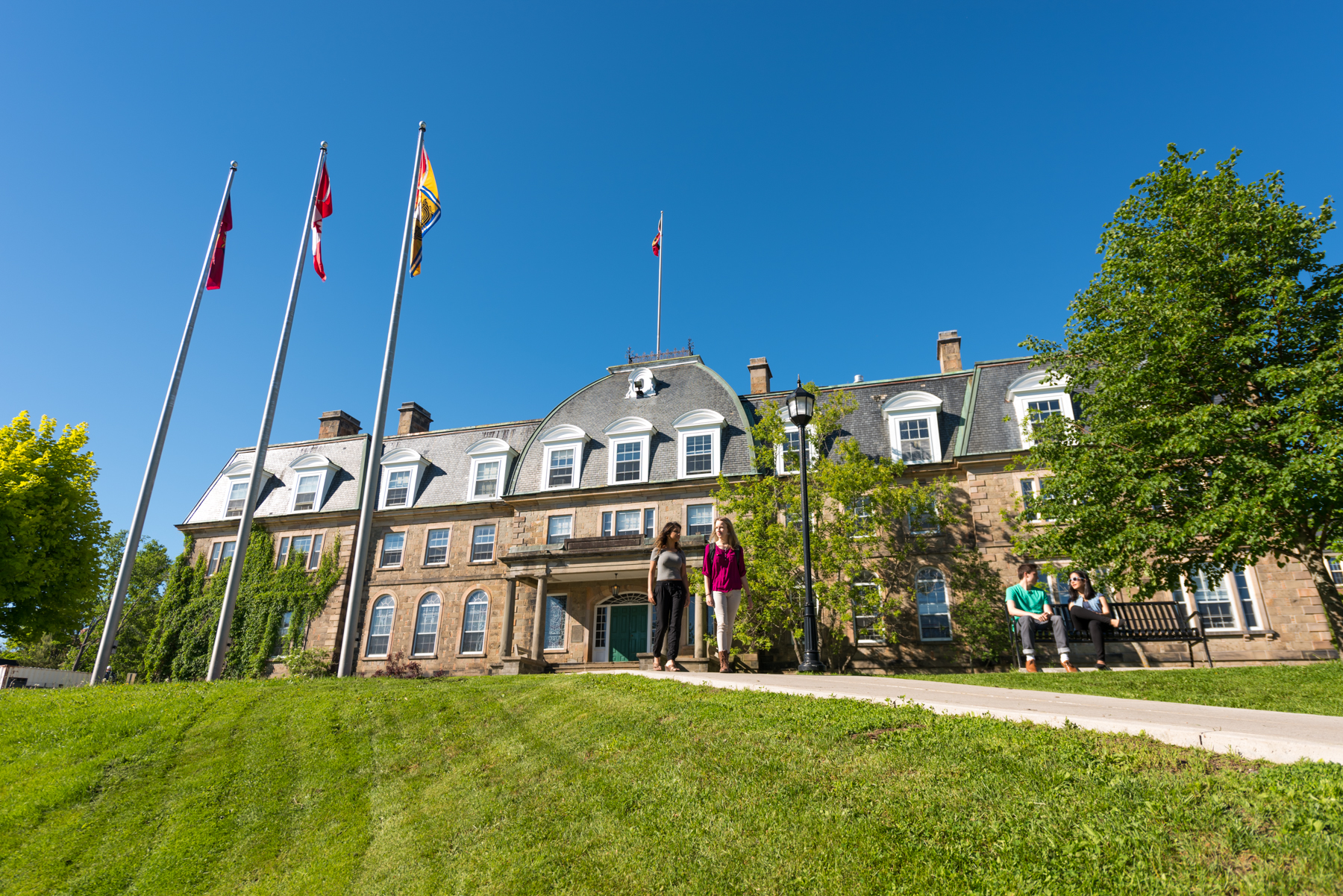
Fredericton is a small capital city, and the UNB campus climbs a hill above the Wolastoq (Saint John River), with Sir Howard Douglas Hall (the Old Arts Building, opened by 1829) at its heart. St. Thomas University shares the campus. Varsity teams play as the UNB Reds in Fredericton and the Seawolves in Saint John. Students run The Brunswickan, founded in 1867, and the city's literary history has earned it the nickname Poets' Corner. Residences range from traditional dorms to suite-style rooms, and most residents buy a meal plan.
- Sir Howard Douglas Hall (Old Arts) and the 1851 William Brydone Jack Observatory are National Historic Sites of Canada.
- Varsity teams: UNB Reds (Fredericton, Atlantic University Sport) and UNB Saint John Seawolves.
- The Brunswickan student newspaper dates from 1867.
- St. Thomas University shares the Fredericton campus.
Housing. Both campuses offer co-ed residences, from traditional dorms to suite-style and family housing; residence fees include heat and internet, and most residents must buy a meal plan.
Location
Fredericton, the capital of New Brunswick, is a compact city of riverside trails and historic streets, and UNB's campus sits on a hill overlooking the Wolastoq (Saint John River). Life is quieter and cheaper than in Toronto or Vancouver. The second campus is in Saint John, New Brunswick's port city on the Bay of Fundy.
Nearest airport: Fredericton International Airport (YFC)
Notable alumni
- BC Bliss CarmanConfederation Poet; BA (1881)
- CG Charles G. D. RobertsConfederation Poet and writer of animal stories; BA (1879) and MA (1881)
- FM Frank McKennaPremier of New Brunswick and Canadian ambassador to the United States; law degree
- GF Gérard La ForestJustice of the Supreme Court of Canada; BCL (1949) and Rhodes Scholar
- DL Dominic LeBlancFederal cabinet minister; Bachelor of Laws
- BH Blaine HiggsPremier of New Brunswick (2018-2024); BSc in mechanical engineering (1977)
- RC Richard CurrieLongtime president of Loblaw and later George Weston Ltd.; entered UNB in 1955 on a Beaverbrook Scholarship before completing his engineering degree elsewhere
Frequently asked questions
What average do you need to get into UNB?
UNB's minimum admission average is 65% for Arts, 70% for Forestry and Environmental Management and 75% for most other programs, including Engineering, Computer Science, Business, Science and Nursing, plus minimum grades in prerequisites.
When is the UNB application deadline for fall 2027?
The general deadline is March 31, but Education closes December 1, Social Work January 31 and Nursing and Health Sciences February 15. All programs keep accepting applications while seats remain.
How much is UNB tuition for international students?
At the Fredericton campus in 2026-27, international tuition is about CA$20,900 a year for Arts, CA$22,500 for Computer Science and CA$25,900 for Engineering, before roughly CA$1,850 in fees and insurance.
Does UNB give scholarships to international students?
Yes. International students apply through the entrance scholarship application by March 1 and are eligible for awards from CA$500 to CA$40,000, including the Lady Vi Aitken Scholarship.
What IELTS score does UNB require?
IELTS Academic 6.5 for most programs, and 7.0 for Nursing, Education and Fredericton Arts. Applicants below the requirement can be admitted conditionally through UNB's English pathway programs.
Sources & methodology
Figures on this page were checked against official university publications, national application services and ranking publishers in September 2026. Each number is shown with the year or admissions cycle it describes. Always confirm deadlines and fees on the university's own website before applying.
Explore nearby in the world top 100
Universities ranked close to UNB in the QS World University Rankings 2027.