Binghamton University, State University of New York
A selective SUNY research university in upstate New York, with in-state tuition near $7,000 and a 37% admit rate.
- Acceptance rate
- 37%
- Fall 2025 entering class (Common Data Set 2025)
- Students
- 18,652
- 14,559 undergraduates
- International
- 7%
- of students
- Student–faculty
- 16:1
- ratio
- Tuition
- $29,840
- 2026-27
About Binghamton
Binghamton University began in 1946 as Triple Cities College, a two-year branch of Syracuse University set up for returning World War II veterans. It joined the State University of New York in 1950 as Harpur College and was named one of SUNY's four university centres in 1965. Today it is a Carnegie R1 research university with about 18,650 students (fall 2025), roughly 14,560 of them undergraduates, on a hillside campus in Vestal, just west of the city of Binghamton.
It is organised into six schools: Harpur College of Arts and Sciences (the oldest and largest), the Thomas J. Watson College of Engineering and Applied Science, the School of Management, the Decker College of Nursing and Health Sciences, the College of Community and Public Affairs, and the School of Pharmacy and Pharmaceutical Sciences. There are more than 130 undergraduate programs, and the Common Data Set shows 61,188 first-year applicants for fall 2025, of whom 22,832 were admitted (37%) and 3,131 enrolled.
Binghamton suits students who want a demanding, research-active education at a public-university price, and who are comfortable on a residential campus rather than in a big city. First-year students must live on campus, and enrolled first-years averaged a 3.88 high school GPA. The admissions office rates rigor of secondary school record and GPA as its most important factors.
Why students choose Binghamton
New York residents pay $7,070 in tuition for 2026-27, and the university reports an average financial aid package of $19,987 for first-year students with demonstrated need.
The Thomas J. Watson College of Engineering and Applied Science offers a five-year BS plus MBA path, and the School of Pharmacy and Pharmaceutical Sciences guarantees a PharmD seat to first-years who join its Pharmacy Early Acceptance Program.
First-year students can join research early through the First-year Research Immersion (sciences and engineering) or the Source Project (humanities and social sciences).
The university reports that more than 1,800 employers recruit its students each year, and that class of 2022 seniors reported average starting salaries of $72,438 against a $55,260 national average.
Admissions
Fall 2025 entering class (Common Data Set 2025)
About 1 in 3 applicants is admitted
22,832 admitted from 61,188 applicants
Middle 50% of admitted students scored in this range.
Middle 50% of admitted students scored in this range.
Admit rate is calculated from CDS C1: 22,832 of 61,188 first-time, first-year applicants (37.3%); the university's admissions data page rounds this to 37%.
Deadlines
- Early Action (BA, first-year) Non-binding Next deadline · In 26 daysNovember 1, 2026
Materials due December 1; decision by January 15.
- BFA/BMus priority (School of the Arts) Non-binding In 56 daysDecember 1, 2026
Portfolio due December 10; regular deadline January 15, 2027 with portfolio by January 25.
- Regular Admission (first-year, domestic) Non-binding In ~3 monthsJanuary 15, 2027
Decision no later than April 1.
- Regular Admission (international first-year) Non-binding In ~5 monthsMarch 15, 2027
Later applications reviewed on a space-available basis; decision by April 1.
Dates are from the university's first-year and international application pages, which show February 2027 auditions and so describe the entry-2027 cycle. Early action is non-binding.
How to apply
Apply with the Common Application, the Coalition Application or the SUNY Application; $50 fee (no fee waivers for international students). Submit a high school transcript (three years of transcripts for international applicants), one teacher or counselor recommendation and, optionally, SAT or ACT scores. International F-1/J-1 applicants also submit English proficiency scores and financial support documents before an I-20 is issued. BFA and BMus applicants add a portfolio or audition.
What admissions looks for
- Rigor of secondary school record and academic GPA, which the CDS rates as very important.
- Class rank and the application essay, rated important.
- Test scores, recommendation, extracurricular activities, talent, character and first-generation status are considered.
- Interview, alumni relations and state residency are not considered.
Tips for applying to Binghamton
- 1 Choose whether to send SAT or ACT scores on your application: the university is test-optional, but the enrolled-student mid-50% is 1320-1480 SAT among those who submitted.
- 2 Apply by November 1 for early action; the university tells early applicants by January 15.
- 3 Applying through the SUNY application's Top 10% Promise does not guarantee admission to Binghamton, so apply to Binghamton directly.
- 4 Pre-pharmacy applicants should select pre-pharmacy as their interest to be considered for the Pharmacy Early Acceptance Program seat.
- 5 Art, theatre and music applicants should confirm their degree program (BA, BFA or BMus) and note the separate portfolio and audition dates.
What are your chances?
Sign up to see your personalized admission chances for Binghamton University, State University of New York
Sign up to see your chancesCosts & financial aid
2026-27 · figures in USD
All applicants are automatically considered for merit scholarships, including the President's, Provost's and Dean's Scholarships, 20 Achievement Scholarships of $10,000 a year and five awards up to the in-state cost of attendance. In the Common Data Set, 299 degree-seeking international (nonresident) undergraduates received institutional aid averaging $7,598. The total cost of attendance shown is the international figure; New York residents' estimate is $30,746.
- $30,746 (New York resident); $53,516 (out-of-state); $56,504 (international)
- Estimated 2026-27 cost of attendance
- 1,457 of 1,458
- First-year students with need who received aid (fall 2025 cohort)
- $19,987
- Average first-year aid package for students with need
- 79%
- Average share of need met (first-year)
Academics
Academic calendar: Semesters
Harpur College liberal arts majors
Popular majors include economics, biology, psychology, integrative neuroscience, environmental studies and English.
Watson College engineering and computer science
Offers a five-year path to a BS and an MBA; employers named by the university include BAE Systems, Lockheed Martin, IBM and Texas Instruments.
Pharmacy Early Acceptance Program
First-years who select pre-pharmacy through the program are offered a guaranteed seat in the PharmD program.
Decker College nursing
Known for the quantity and quality of its clinical practice placements.
School of Management
Tight-knit cohort with national case competitions, internships and study abroad.
School of the Arts
Offers BA, BFA and BMus routes, with Art & Design, Musical Theatre and Music Performance requiring portfolios or auditions.
Research
- Carnegie R1 (very high research activity); sponsored program expenditures were $103.3 million in 2025-26.
- Undergraduate research is built into the first year through First-year Research Immersion and the Source Project.
- The Innovative Technologies Complex houses biotechnology, engineering and a Small Scale Systems Integration and Packaging Center (a New York State Center of Excellence).
Schools & faculties
- Harpur College of Arts and Sciences
- Thomas J. Watson College of Engineering and Applied Science
- School of Management
- Decker College of Nursing and Health Sciences
- College of Community and Public Affairs
- School of Pharmacy and Pharmaceutical Sciences
Class of 2022 Senior Survey reports average starting salaries of $72,438, versus $55,260 nationally (NACE). About 49% of graduates pursue further education.
Student life
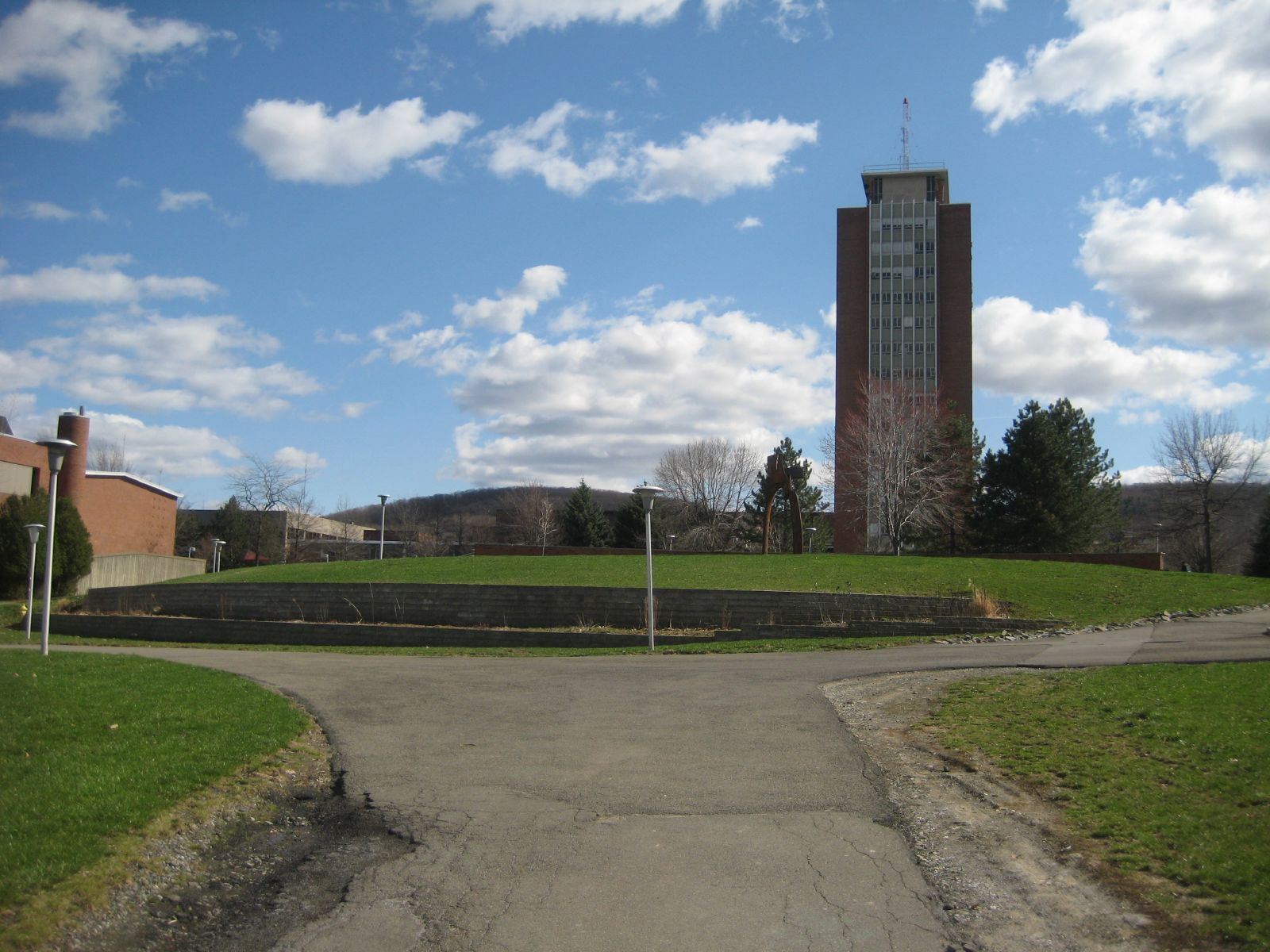
Binghamton is a residential campus on a wooded hillside. First-year students are required to live on campus in one of five residential communities, each with its own dining hall, quad and traditions, such as Newing College's Newing Navy week and College-in-the-Woods' Casino in the Woods fundraiser. Transfers and upper-level students can move to the Apartments Community. More than 280 student clubs and organizations are listed on the admissions site, and the Bearcats compete in NCAA Division I in the America East Conference.
- Five first-year residential communities plus the Apartments Community for transfers and upperclass students.
- More than 280 student-run clubs and organizations.
- NCAA Division I Bearcats in the America East Conference.
- A 190-acre Nature Preserve on the southern end of campus.
Housing. First-year students are required to live on campus, in communities such as College-in-the-Woods, Dickinson, Hinman, Mountainview and Newing.
Location
The campus is in the Southern Tier of upstate New York, about one mile west of the city of Binghamton in the town of Vestal. The university lists driving times of about 3 hours to New York City and Philadelphia and about 5 hours to Boston, Washington, Toronto and Montreal. It describes the cost of living in the Greater Binghamton area as low and provides free bus transportation to campus.
Nearest airport: Greater Binghamton Airport (BGM)
Notable alumni
- PA Peter AltabefBusinessman and CEO of Unisys; economics graduate, class of 1980
- TS Thomas SecundaCo-founder and vice-chairman of Bloomberg L.P.; bachelor's and master's degrees in mathematics
- BS Bob SwanBusinessman and former CEO of Intel; MBA, class of 1985
- JR Julie RiceEntrepreneur and co-founder of SoulCycle; English and theater graduate
- SH Sunny HostinLawyer and television host; English and rhetoric graduate, class of 1990
- SC Stephanie CourtneyActress and comedian best known as Flo in Progressive Insurance advertising; English graduate, class of 1992
- SC Steven CanalsScreenwriter and producer, co-creator of the television series Pose; BA in cinema (2005) and MA (2008)
- WB William BaldwinFilm actor; degree in political science, varsity wrestler
Frequently asked questions
What is Binghamton University's acceptance rate?
For the fall 2025 entering class, 22,832 of 61,188 first-year applicants were admitted, an admit rate of about 37%.
Does Binghamton require the SAT or ACT?
No. Binghamton is test-optional. Among enrolled students who submitted scores, the middle 50% ranged from 1320 to 1480 on the SAT and 31 to 34 on the ACT.
How much does Binghamton cost for international students?
The 2026-27 estimated annual cost of attendance for international students is $56,504: $29,840 tuition, $6,485 fees and $20,179 for housing and meals. The university notes the SEVIS fee is not included.
What are Binghamton's application deadlines for 2027 entry?
Early action is November 1, 2026. Regular admission is January 15, 2027 for domestic applicants and March 15, 2027 for international first-year applicants.
Is Binghamton good for engineering and business?
Binghamton's Watson College of Engineering and Applied Science and School of Management are two of its six schools, and Watson offers a five-year BS and MBA option.
Sources & methodology
Figures on this page were checked against official university publications, national application services and ranking publishers in September 2026. Each number is shown with the year or admissions cycle it describes. Always confirm deadlines and fees on the university's own website before applying.
Explore nearby in the world top 100
Universities ranked close to Binghamton in the QS World University Rankings 2027.