
FAFSA 2026-2027 Strategy: How to Maximize Aid After You Submit
Most families treat FAFSA like a form. Submit it, wait, hope. That is not enough. The 2026-2027 financial aid cycle rewards families who file early, check details, compare offers carefully, and appeal when the numbers do not reflect reality.
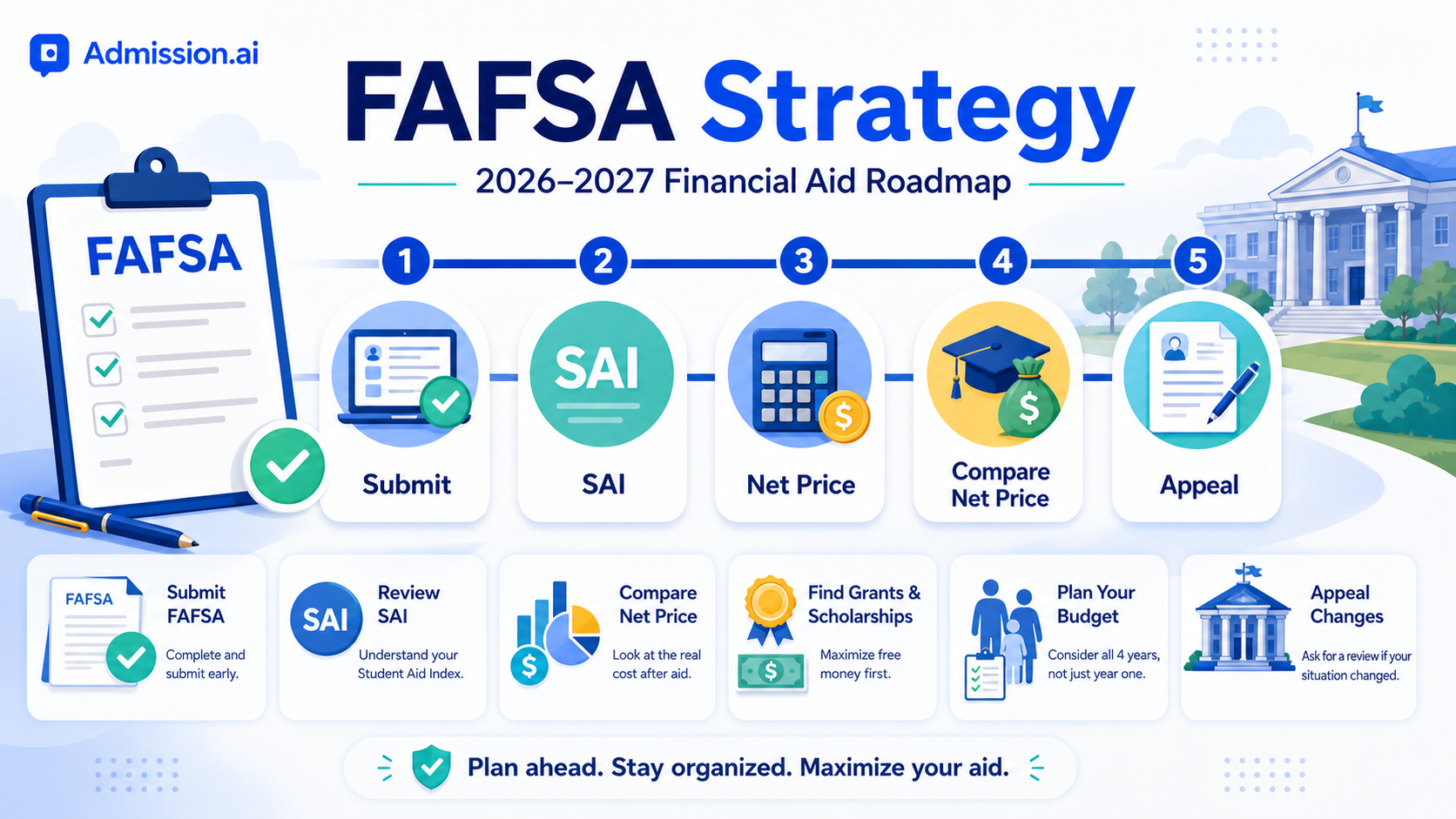
Financial aid strategy begins after the FAFSA is submitted.
Start With the Right Timeline
For the 2026-2027 aid year, the FAFSA is tied to enrollment from July 1, 2026 through June 30, 2027. Students should submit as early as possible once the form opens for their aid year because state, college, and scholarship deadlines can be earlier than the federal deadline.
Do not wait for admission decisions. Many colleges want aid forms before they release decisions, especially for Early Decision, Early Action, priority scholarships, and institutional grants.
Step 1: Check the FAFSA Submission Summary
After submitting, review the FAFSA Submission Summary. This is where mistakes surface.
Check:
- Student and parent identity information
- Dependency status
- Household size
- Colleges listed
- Consent and approval for federal tax information transfer
- Reported assets if required
- Any flags requiring correction
Small errors can delay processing or distort aid eligibility. Fix them quickly.
Step 2: Confirm Every College Received It
Submitting FAFSA is not the same as completing every college's financial aid process.
After submission:
- Log into each applicant portal
- Check whether FAFSA is marked received
- Look for missing documents
- Confirm whether CSS Profile is required
- Check whether IDOC or institutional forms are required
- Save screenshots or confirmations for important deadlines
Financial aid offices process thousands of files. Do not assume silence means completion.
Step 3: Understand Student Aid Index
The Student Aid Index, or SAI, replaced the old Expected Family Contribution. It is not a bill. It is a federal eligibility measure that colleges use as one input when building aid packages.
Families often misunderstand SAI in two ways:
- A low SAI does not guarantee that every college will be affordable
- A high SAI does not mean you should skip aid forms
Many colleges require FAFSA for merit scholarships, work-study, loans, emergency grants, or future-year eligibility even when need-based aid seems unlikely.
Step 4: Watch State Aid Deadlines
State aid is easy to miss because each state runs its own process. Some states have priority deadlines, some have first-come funding, and some require separate forms after FAFSA.
Your checklist should include:
- FAFSA submitted
- State grant application completed if separate
- Residency requirements reviewed
- GPA verification submitted if required
- Community college or public university deadlines checked
Missing a state deadline can cost more than missing a private scholarship.
Find your perfect university match
Get personalized recommendations based on your profile and goals.
Step 5: Compare Net Price, Not Award Size
A college can offer a large scholarship and still be expensive. Another college can offer a smaller award but have a lower final cost.
Compare:
- Tuition and fees
- Housing and food
- Books, travel, and personal expenses
- Grants and scholarships
- Work-study
- Federal loans
- Parent PLUS loans
- Remaining out-of-pocket cost
Separate free money from debt. A $20,000 package with $8,000 in loans is not the same as a $20,000 grant.
Step 6: Appeal When Circumstances Changed
FAFSA uses tax information from a prior year. If your family's current situation is different, the aid offer may be wrong.
Appeal if there has been:
- Job loss or reduced income
- Medical expenses
- Divorce or separation
- Death of a parent or guardian
- One-time income that will not repeat
- Natural disaster or unusual family expense
- Change in sibling enrollment costs
Financial aid appeals should be factual, documented, and concise. Do not write an emotional essay. Explain the change, show documents, and ask for reconsideration.
Step 7: Ask Better Questions
When contacting financial aid offices, avoid vague questions like "Can I get more money?"
Ask:
- Is this award renewable for four years?
- What GPA is required to keep this scholarship?
- Does the grant change if housing status changes?
- Are there departmental scholarships for my major?
- Can the offer be reviewed due to changed financial circumstances?
- How much of this package is loan versus grant?
- What is the typical net price increase after first year?
Good questions reveal the real cost.
Step 8: Plan for Year Two
The first-year package is not the whole story. Some scholarships are front-loaded. Housing costs can rise. Meal plans change. Travel costs become clearer. Families should ask what happens after freshman year.
Build a four-year affordability view:
- Expected annual cost increases
- Renewal requirements
- Loan totals by graduation
- Work expectations
- Summer earnings assumptions
- Major-specific fees
Avoid choosing a college that works for one year and becomes impossible by junior year.
How admission.ai Helps
admission.ai helps students manage financial aid alongside admissions deadlines. Use it to track FAFSA, CSS Profile, scholarship deadlines, college portals, award comparisons, and appeal tasks in one place.
The best college choice is not simply the most prestigious acceptance. It is the strongest combination of academic fit, personal fit, and financial sustainability.
Bottom Line
FAFSA submission is the beginning, not the finish line. Families who verify, compare, appeal, and plan across four years make better decisions and avoid preventable debt.
File early. Check everything. Compare net price. Ask questions. Then choose with full information.
Continue Reading
More articles you might enjoy