
Early Decision vs Early Action 2026: Which Strategy Maximizes Your Chances?
Early applications have become important for college admissions success. At elite schools, Early Decision acceptance rates are often 2-4 times higher than Regular Decision. But understanding the difference between Early Decision and Early Action-and choosing the right strategy-can make or break your admissions chances.
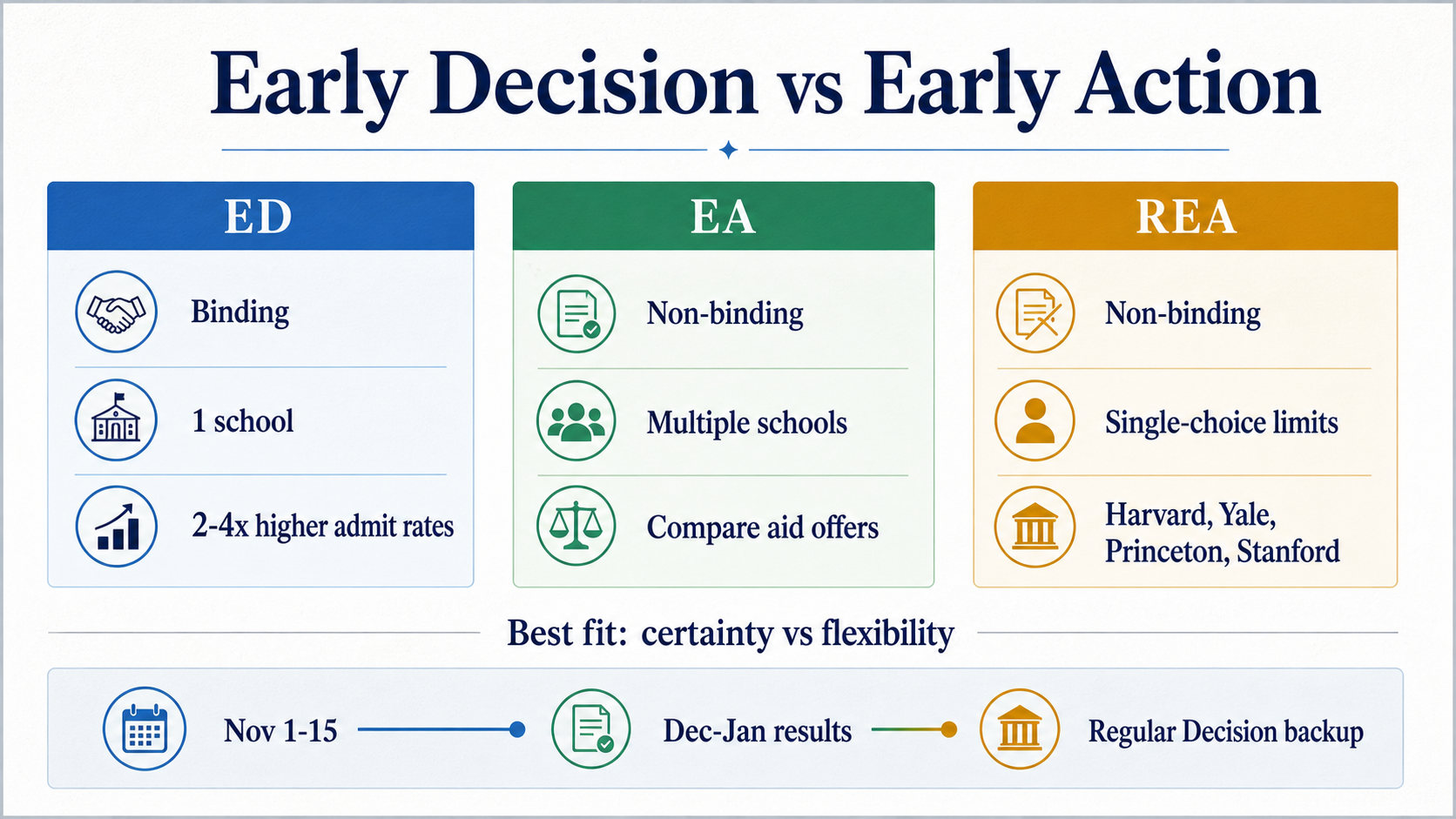
Early Decision vs Early Action: Key Differences
Early Decision (ED)
- Binding commitment: You must attend if accepted
- Single school only: Can only apply ED to one institution
- Higher acceptance rates: Often 2-4x higher than Regular Decision
- Financial aid concerns: Harder to compare aid offers
- Deadline: Usually November 1 or November 15
Early Action (EA)
- Non-binding: You can decline the offer
- Multiple schools allowed: Apply EA to several institutions
- Moderate acceptance boost: Better than RD, not as much as ED
- Financial flexibility: Can compare aid packages
- Deadline: Typically November 1 to December 1
Restrictive Early Action (REA)
Some schools offer a hybrid option:
- Non-binding like EA
- Single school only like ED
- Restricts other early applications: Usually can't apply ED or EA elsewhere
- Schools offering REA: Stanford, Harvard, Yale, Princeton
Early Decision Acceptance Rate Advantage 2026
The numbers tell a compelling story about Early Decision's advantage:
Harvard University:
- Early Action: 7.5% acceptance rate
- Regular Decision: 2.7% acceptance rate
Columbia University:
- Early Decision: 15.1% acceptance rate
- Regular Decision: 3.9% acceptance rate
Northwestern University:
- Early Decision: 22% acceptance rate
- Regular Decision: 7% acceptance rate
Duke University:
- Early Decision: 21% acceptance rate
- Regular Decision: 5.8% acceptance rate
This advantage exists because schools can count on ED admits attending, helping them manage yield rates and rankings.
When to Choose Early Decision
Early Decision makes sense when:
You Have a Clear Top Choice
ED should only be used when you're 100% certain about your preferred school. Ask yourself: "If I got into every college in the world, would I still choose this one?"
Financial Aid Isn't Your Primary Concern
Since ED is binding, you can't compare aid packages. Only apply ED if:
- Your family can afford the school regardless of aid
- You've run the net price calculator and can live with the estimate
- You're willing to take on debt for your dream school
Your Profile Matches the School
ED works best when your academic stats (GPA, test scores) fall within or above the school's middle 50% range. If you're below their typical admitted student profile, the ED advantage may not be enough.
You're Not Seeking Merit Aid
Many merit scholarships have later deadlines or go to students schools want to attract from their regular decision pool.
When to Choose Early Action
Early Action is often the smarter strategy when:
You Want to Apply to Multiple Elite Schools
EA lets you apply early to several schools, giving you options and peace of mind. You might apply EA to:
- MIT (EA required for consideration)
- Georgetown (first year on Common App)
- University of Michigan
- Boston College
- Northeastern University
Financial Aid Matters
EA allows you to compare aid packages from multiple schools in the spring, potentially saving thousands of dollars.
You're Still Developing Your College List
EA gives you more time to finalize your preferences while still getting early consideration.
You Want Maximum Flexibility
With EA, you can change your mind based on acceptances, aid offers, and campus visits in the spring.
2026-Specific Considerations
Georgetown Joins Common App
For the first time, Georgetown accepts Common App applications starting fall 2026. This makes their EA option more accessible but may increase competition.
Test-Required Schools Are Back
Many schools that went test-optional are requiring standardized tests again for 2026. Make sure your scores are competitive before applying early.
Increased Early Application Volume
More students are applying early each year. The advantage still exists, but competition in early rounds continues to intensify.
Early Decision II Strategy
Some schools offer ED II with January deadlines. This option works well for students who:
- Were deferred or rejected from their ED I choice
- Developed a new top choice after visiting campuses
- Improved their profile during senior year fall
- Want the ED advantage with more time to prepare
Top ED II Schools:
- Vanderbilt University
- Washington University in St. Louis
- Emory University
- Claremont McKenna College
- Pomona College
- Swarthmore College
Find your perfect university match
Get personalized recommendations based on your profile and goals.
Financial Aid Considerations for Early Applications
Running Net Price Calculators
Before applying ED, use each school's net price calculator with your family's actual financial information. These estimates aren't perfect, but they provide a baseline.
CSS Profile Requirements
Most early applicants must submit the CSS Profile by November deadlines. This requires 2024 tax information, so prepare early.
Early FAFSA Filing
Complete FAFSA immediately when it opens October 1, 2026. Some schools have priority deadlines for early applicants.
Appeal Process Understanding
If you apply ED and receive insufficient aid, you can appeal to the financial aid office. In extreme cases, schools may release you from the binding commitment, though this is rare.
Building Your Early Application Strategy
The 40-40-20 Rule
Consider this approach for applying early:
- 40% Early Action: Apply EA to schools where you'd be happy attending
- 40% Early Decision: Use ED for your absolute top choice (if applicable)
- 20% Regular Decision: Save some applications for schools you discover or programs with January deadlines
Timing Your Applications
Summer before senior year:
- Research early options at target schools
- Begin essays for early applications
- Plan standardized testing to meet early deadlines
September 2026:
- Finalize early application schools
- Complete first drafts of all early essays
- Request transcripts and recommendation letters
October 2026:
- Submit early applications
- Complete FAFSA and CSS Profile
- Take final standardized tests if needed
Common Early Application Mistakes
Applying ED for the Wrong Reasons
Don't apply ED just because acceptance rates are higher. The binding commitment is serious, and buyer's remorse is real.
Not Understanding Restrictions
Restrictive Early Action has specific rules about other applications. Read the fine print carefully.
Poor Financial Planning
Don't apply ED hoping financial aid will work out. Have honest conversations about affordability before applying.
Rushing Application Quality
The early deadline advantage is meaningless if your application isn't your best work. Start early to allow time for quality essays and reviews.
Ignoring Demonstrated Interest
Some EA schools track demonstrated interest. Visit campuses, attend virtual events, and engage with admissions representatives.
Making the Decision: ED vs EA vs RD
Use this framework to decide your early application strategy:
- Identify your top choice: Is there one school you'd choose above all others?
- Assess financial constraints: Can your family afford any school, or is aid comparison essential?
- Evaluate your competitive profile: Are your stats competitive for your target schools?
- Consider your timeline: Do you have time to create quality applications by early deadlines?
- Plan for different outcomes: What happens if you're accepted, rejected, or deferred?
How admission.ai Can Help
Choosing between ED and EA involves complex strategic decisions. admission.ai provides:
- Personalized strategy recommendations based on your profile and preferences
- Acceptance probability calculations for different application strategies
- Essay feedback and optimization to strengthen early applications
- Deadline tracking and reminders to ensure you never miss important dates
For $10/month, get expert-level guidance on whether to apply ED, EA, or wait for Regular Decision based on your unique situation.
The Bottom Line
Early applications provide a real advantage in college admissions, but strategy matters. Early Decision offers the biggest boost but requires absolute certainty and financial flexibility. Early Action provides a moderate advantage with maximum flexibility.
Most successful applicants combine both strategies: EA to several schools they'd happily attend, and possibly ED to their dream school if circumstances align.
The key is making an informed decision based on your specific situation rather than following generic advice. Whether you choose ED, EA, or focus on Regular Decision, starting early and maintaining quality throughout your applications matters most.
Your early application strategy could be the difference between acceptance and rejection at your dream school. Choose wisely, prepare thoroughly, and remember that admission.ai is here to help you through these complex decisions.
Continue Reading
More articles you might enjoy
 College Admissions
Common App Direct Admissions 2026: What It Means and How Students Should Use It
Direct admissions is expanding, giving some students proactive college offers before a traditional application. Learn what it is, who benefits, and how to use it wisely.
 College Admissions
College Application Deadlines 2027: Complete Calendar for Class of 2031
Every college application deadline for 2027 in one place. Early Decision, Early Action, Regular Decision, financial aid, and scholarship dates for the Class of 2031.
 College Admissions
College Admissions 2026 Timeline: Complete Class of 2030 Guide
The definitive timeline for college admissions 2026. Everything Class of 2030 students need to know about key dates, deadlines, and strategic planning from junior year through commitment.