
Common App Direct Admissions 2026: What It Means and How Students Should Use It
Direct admissions is one of the most important access changes in college admissions. Instead of forcing every student to chase colleges first, participating colleges can proactively offer admission to students who meet their criteria.
For some applicants, this can reduce stress, create earlier options, and make college feel more reachable. But direct admissions is not a replacement for strategy. It is a new layer in the process.
What Direct Admissions Means
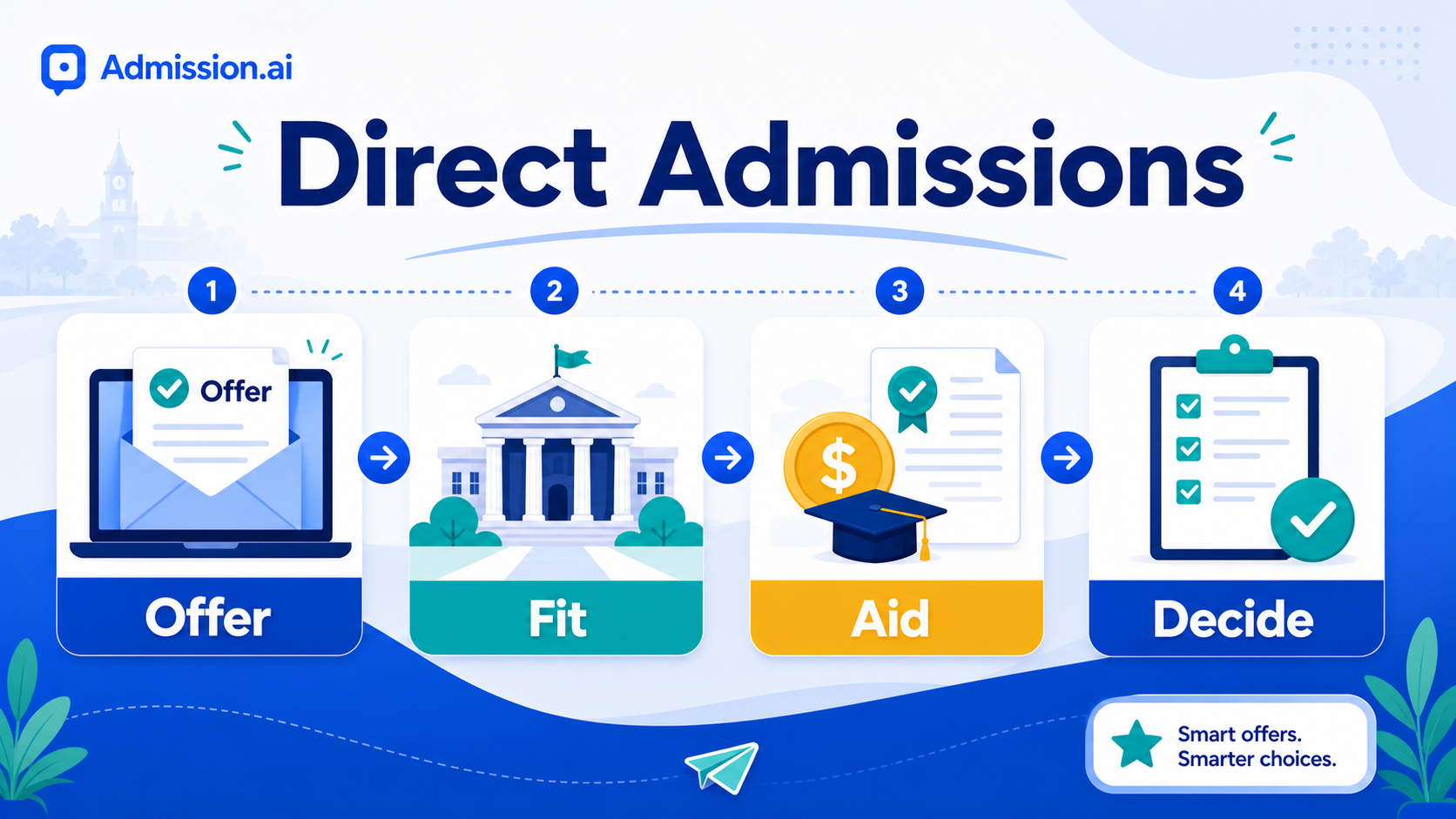
In a traditional application, the student applies first and waits for a decision. In direct admissions, a college identifies students who appear admissible based on available information and extends a proactive offer or invitation.
The exact process varies by platform, state, and institution, but the core idea is simple: colleges can say, "Based on what we know, you are admissible here," before the student completes a full traditional application.
Common App has been expanding direct admissions with member colleges, especially to reach first-generation and low- to middle-income students who might otherwise underestimate their options.
Why Colleges Are Doing This
Direct admissions helps colleges solve several problems:
- Many qualified students never apply because the process feels intimidating
- Smaller and regional colleges need better ways to reach good-fit applicants
- First-generation students often lack admissions guidance
- Application fees and uncertainty discourage students from building balanced lists
- Colleges want to reduce friction between eligibility and enrollment
For students, the benefit is psychological as much as procedural. Having an early offer can make the entire college process feel less like a lottery.
What Direct Admissions Does Not Mean
Direct admissions does not mean every cost is covered. It does not mean the college is automatically the best fit. It does not mean the student can ignore financial aid forms, housing deadlines, major requirements, or scholarship applications.
Most importantly, it does not mean the student should stop building a thoughtful list.
Think of direct admissions as an option generator, not a final decision.
Who Benefits Most
Direct admissions can be especially useful for:
- Students who are unsure whether they are "college material"
- First-generation applicants
- Students with limited counseling support
- Students who need affordable regional options
- Applicants who want a safety net before selective decisions arrive
- Students who are open to strong colleges outside the most famous names
It is less useful for students who are only focused on highly selective private universities, because direct admissions is usually more common among access-oriented institutions and schools with clearer admissibility thresholds.
How to Evaluate a Direct Admission Offer
Do not accept emotionally. Evaluate it like any other college option.
Ask:
- Is my intended major available and strong?
- What is the net price after aid, not just sticker price?
- What are retention and graduation rates?
- Are honors programs or scholarships available?
- Can I see myself living there for four years?
- What career outcomes does the program support?
- Are transfer pathways clear if I later change direction?
An offer is valuable only if it fits your goals and finances.
Find your perfect university match
Get personalized recommendations based on your profile and goals.
Direct Admissions and Financial Aid
This is the part students often miss. Admission and affordability are separate.
After receiving a direct admissions offer, you still need to:
- Submit the FAFSA
- Complete any state aid forms
- Complete CSS Profile if the school requires it
- Apply for institutional scholarships
- Compare net price across schools
- Ask about merit aid deadlines
A direct offer with weak aid may be less useful than a traditional admission with a strong scholarship.
How It Changes Your College List
Direct admissions should make your college list more resilient. If you receive proactive offers, you can reduce panic-applying to random safeties. But you should still maintain a balanced list:
- 2 to 3 likely schools you would genuinely attend
- 3 to 5 target schools
- 2 to 4 reach schools
- Any direct admissions offers worth considering
Do not let direct offers crowd out ambition. Also do not let prestige blind you to a college that may be affordable, supportive, and academically aligned.
What Students Should Do Now
To benefit from direct admissions:
- Create or update your Common App profile early
- Enter accurate academic information
- Keep your college preferences broad enough to discover options
- Read every offer carefully
- Track scholarship and aid deadlines separately
- Visit or attend virtual sessions before committing
- Compare outcomes, not just names
Direct admissions works best when your profile is complete and accurate.
Common Mistakes
The biggest mistake is treating direct admissions as "lesser" admission. Many strong colleges participate because they want to reach students more efficiently, not because the education is weak.
The second mistake is assuming the offer is free. It may still require forms, deposits, financial aid documents, and deadlines.
The third mistake is ignoring fit. A college can admit you and still be wrong for your major, budget, or support needs.
How admission.ai Helps
admission.ai can help you compare direct admissions offers against the rest of your list. The key is not "Should I accept this because they accepted me?" The better question is "Where does this option sit in my academic, financial, and career strategy?"
Use the platform to organize deadlines, compare colleges, test fit, and avoid missing the financial aid steps that make an offer real.
Bottom Line
Direct admissions is good for students. It reduces uncertainty and expands access. But the best applicants will treat it as one tool inside a broader plan.
An early yes is useful. A well-chosen yes is better.
Continue Reading
More articles you might enjoy
 College Admissions
College Application Deadlines 2027: Complete Calendar for Class of 2031
Every college application deadline for 2027 in one place. Early Decision, Early Action, Regular Decision, financial aid, and scholarship dates for the Class of 2031.
 College Admissions
College Admissions 2026 Timeline: Complete Class of 2030 Guide
The definitive timeline for college admissions 2026. Everything Class of 2030 students need to know about key dates, deadlines, and strategic planning from junior year through commitment.
 College Admissions
College Application Deadlines 2026: Complete Calendar for Class of 2030
Never miss another deadline. Complete list of college application deadlines for 2026, including Early Decision, Early Action, Regular Decision, and financial aid dates.